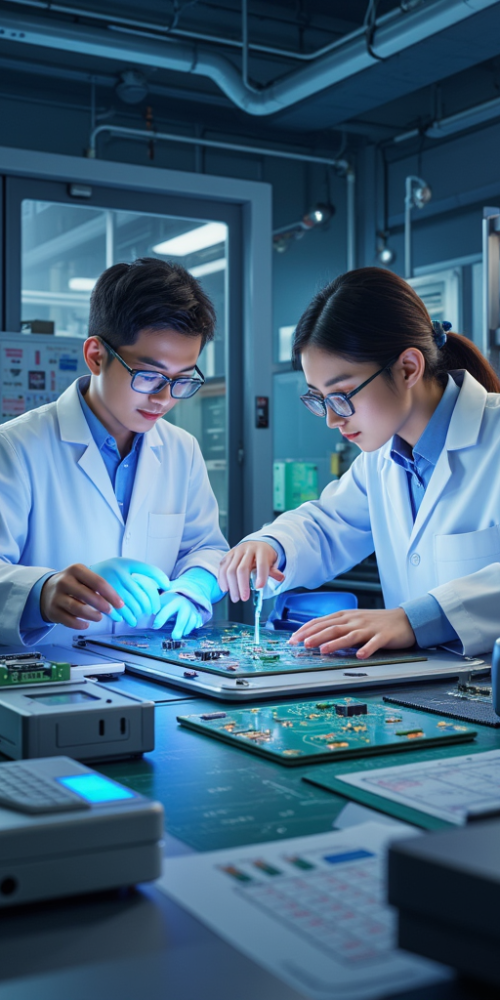
Printed Circuit Board Assembly (PCBA) is a fundamental process in electronics manufacturing that converts a bare printed circuit board into a fully functional electronic unit. PCBA plays a decisive role in determining the performance, reliability, manufacturability, and lifespan of electronic products across industries.
This article provides a systematic and in-depth explanation of PCBA, covering its definition, manufacturing process, assembly technologies, materials, testing methods, applications, and cost factors. It serves as a foundational reference within a PCBA knowledge series.
Table of Contents
- What Is PCBA?
- The Role of PCBA in Electronics Manufacturing
- PCB vs PCBA: Key Differences
- Detailed PCBA Manufacturing Process
- PCBA Assembly Technologies
- PCBA Structural Types
- Materials and Components Used in PCBA
- PCBA Testing and Quality Control
- PCBA Applications by Industry
- PCBA Cost Structure and Influencing Factors
- Common PCBA Quality Risks
- Frequently Asked Questions (FAQ)
1. What Is PCBA?
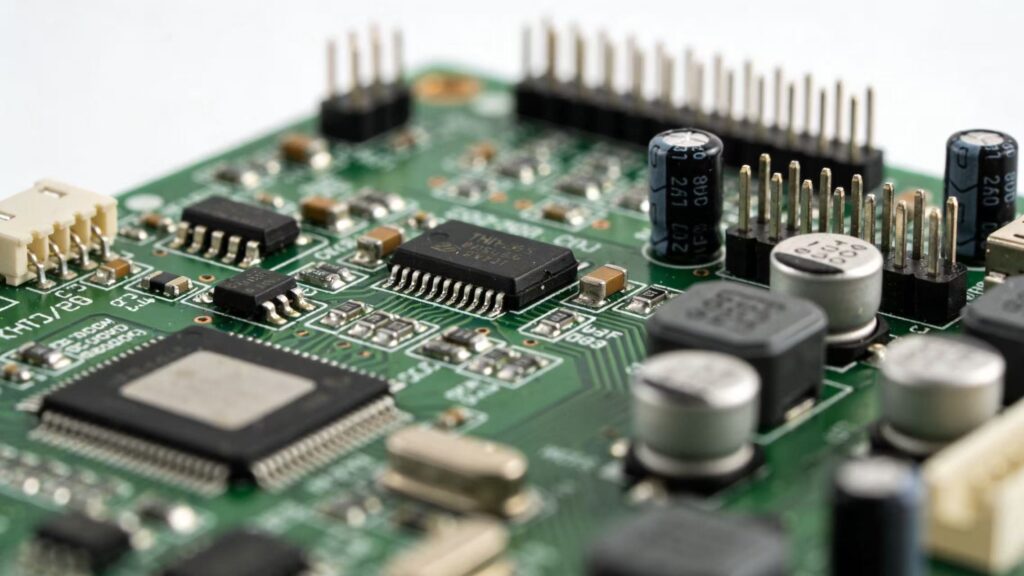
PCBA (Printed Circuit Board Assembly) refers to a printed circuit board (PCB) that has electronic components mounted and soldered onto it, forming a complete and operational electronic assembly.
Unlike a bare PCB, a PCBA can:
- Conduct electrical signals
- Control system logic
- Manage power distribution
- Interface with other electronic modules
PCBA is an essential intermediate or final product used in electronic systems.
2. The Role of PCBA in Electronics Manufacturing
In electronics manufacturing, PCBA represents the transition from design to functional hardware. It integrates circuit design, component selection, assembly technology, and quality control into a single manufacturing stage.
PCBA directly affects:
- Electrical performance
- Thermal behavior
- Mechanical stability
- Product reliability
- Production yield
Most electronic failures in the field can be traced back to issues originating during the PCBA stage.
3. PCB vs PCBA: Key Differences
| Aspect | PCB | PCBA |
|---|---|---|
| Definition | Bare circuit board | Assembled circuit board |
| Components | None | Installed and soldered |
| Functionality | Non-functional | Fully functional |
| Manufacturing Stage | Early | Final or near-final |
| Testing | Material & impedance | Electrical & functional |
Understanding the distinction between PCB and PCBA is essential when defining manufacturing scope and technical requirements.
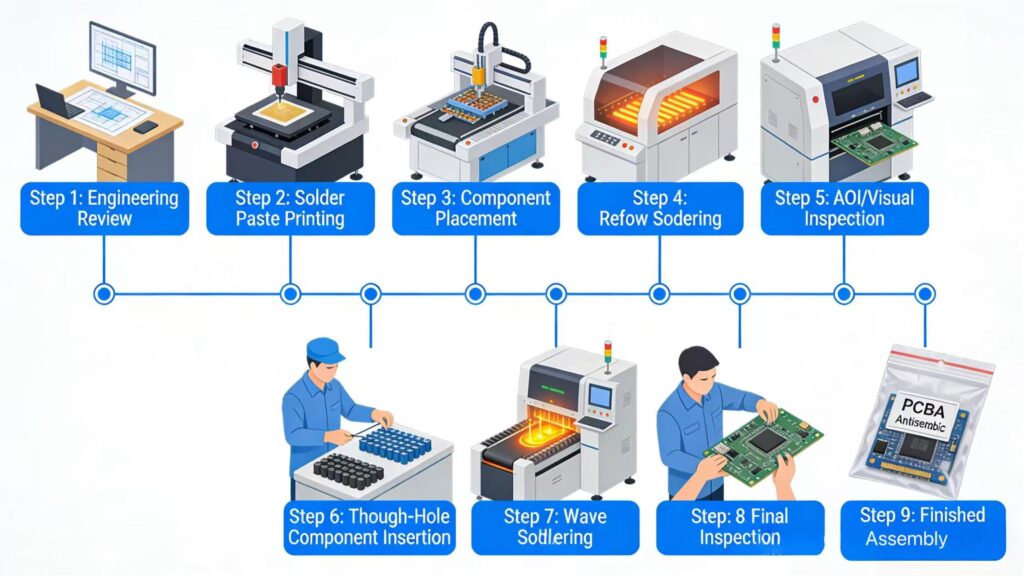
4. Detailed PCBA Manufacturing Process
4.1 Engineering Review and DFM Analysis
Before assembly, manufacturers conduct:
- Design for Manufacturability (DFM)
- Design for Assembly (DFA)
- Footprint and pad verification
- BOM accuracy and compatibility checks
This step minimizes assembly defects and reduces redesign risk.
4.2 Component Sourcing and Preparation
Key activities include:
- Component specification verification
- Moisture sensitivity level (MSL) control
- Anti-counterfeit inspection
- Traceability management
Component quality directly impacts PCBA reliability and consistency.
4.3 Solder Paste Printing
- Application of solder paste using metal stencils
- Control of solder volume and alignment
- Solder Paste Inspection (SPI)
Inaccurate solder paste deposition is a primary cause of soldering defects.
4.4 SMT Component Placement
- Automated pick-and-place equipment
- High-precision alignment systems
- Placement of fine-pitch components such as BGA and QFN
- Electrostatic discharge (ESD) protection
Placement accuracy influences yield and long-term reliability.
4.5 Reflow Soldering
- Multi-zone temperature profiling
- Controlled heating and cooling
- Nitrogen reflow for high-density assemblies
- Protection of moisture-sensitive devices
Improper reflow profiles can cause cold joints, voids, or component damage.
4.6 Through-Hole Assembly (THT)
- Manual or automated insertion
- Wave soldering or selective soldering
- Reinforcement for mechanically stressed components
THT is commonly used for connectors, transformers, and power devices.
4.7 Cleaning and Post-Assembly Handling
- Removal of flux residues
- Ionic contamination control
- Anti-static handling and packaging
- Moisture protection
5. PCBA Assembly Technologies
Surface Mount Technology (SMT)
- High component density
- Fully automated process
- Suitable for most modern electronics
Through-Hole Technology (THT)
- Strong mechanical connection
- Suitable for high-current or high-stress environments
Mixed Assembly
- Combination of SMT and THT
- Common in industrial and automotive electronics
6. PCBA Structural Types
- Single-sided PCBA
- Double-sided PCBA
- Multilayer PCBA
- Rigid PCBA
- Flexible PCBA
- Rigid-flex PCBA
Selection depends on circuit complexity, space constraints, and operating environment.
7. Materials and Components Used in PCBA
PCB Base Materials
- FR-4
- High-Tg FR-4
- Aluminum-based PCBs
- Polyimide for flexible circuits
Surface Finishes
- ENIG (Electroless Nickel Immersion Gold)
- HASL
- OSP
Material choice affects thermal performance, signal integrity, and durability.
8. PCBA Testing and Quality Control
Quality assurance typically includes:
- Visual inspection
- Automated Optical Inspection (AOI)
- X-ray inspection for hidden solder joints
- In-Circuit Testing (ICT)
- Functional testing
- Burn-in testing for high-reliability applications
Testing ensures compliance with design specifications and industry standards.
9. PCBA Applications by Industry
PCBA is widely used in:
- Consumer electronics
- Industrial automation
- Medical devices
- Automotive electronics
- Telecommunications equipment
- IoT and smart devices
- Aerospace and defense systems
Different applications impose different reliability and compliance requirements.
10. PCBA Cost Structure and Influencing Factors
PCBA cost is influenced by:
- Board complexity and layer count
- Component selection and availability
- Assembly technology
- Testing requirements
- Production volume
- Yield and scrap rate
Design optimization can significantly reduce overall manufacturing cost.
PCBA is a critical stage in electronics manufacturing that directly connects circuit design with real-world product performance. From component sourcing and assembly technologies to material selection and quality control, every step in the PCBA process influences reliability, consistency, and long-term stability.
A clear understanding of PCBA fundamentals helps readers better evaluate manufacturing requirements, interpret technical specifications, and assess quality risks across different applications. As electronic products continue to evolve toward higher integration and greater complexity, PCBA remains a foundational element that supports innovation, scalability, and industrial progress.
Yuxun Electronics Technology Co., Ltd. was established in October 2008. The company deeply integrates printed circuit board assembly (PCBA) and specializes in the customized R&D and manufacturing of high-end smart toy products. We have served over 2,000 domestic and international clients to date.
We look forward to your visit and collaboration.
11. Common PCBA Quality Risks
- Insufficient DFM analysis
- Inconsistent component quality
- Inadequate soldering control
- Insufficient inspection coverage
- Poor traceability
Effective process control and testing reduce these risks.
12. Frequently Asked Questions (FAQ)
Q1: Is PCBA the same as PCB?
No. PCB is the bare board, while PCBA is the assembled and functional board.
Q2: What files are required for PCBA manufacturing?
Gerber files, BOM, pick-and-place files, and assembly drawings.
Q3: What assembly technologies are used in PCBA?
SMT, THT, and mixed assembly.
Q4: Why is PCBA testing important?
Because many assembly defects are not visible without inspection or electrical testing.
Q5: Can PCBA be customized for different applications?
Yes. PCBA is fully customized based on design and application requirements.